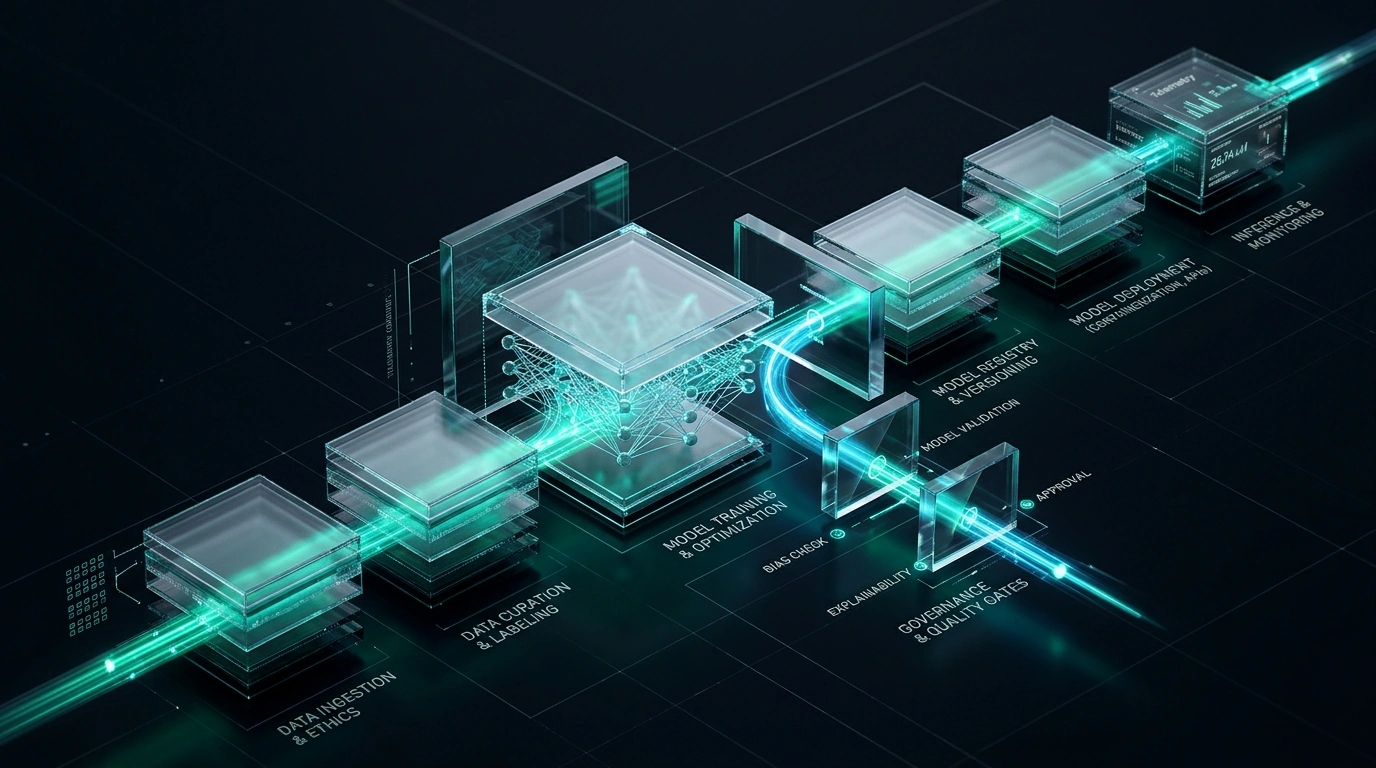
The Stage-Gate Principle
In aerospace and automotive engineering, safety-critical components pass through rigorous stage gates before physical assembly. MIZAN (mizan.hennt.in) brings that exact engineering discipline to artificial intelligence through automated Gates 1, 2, and 3 validation.
Why Traditional Unit Tests Fail for AI Models
In traditional software development, functions are deterministic: add(2, 2) always returns 4. But Large Language Models and probabilistic neural networks are non-deterministic. A subtle change in system prompt wording, a temperature adjustment, or a new fine-tuning dataset can inadvertently break edge cases, trigger toxic outputs, or inflate response latencies by 300%.
Without automated stage gates, enterprise teams discover these regressions only after frustrated clients complain. HENNT built MIZAN's Gates 1–3 pipeline to turn AI quality from an anxious guessing game into an automated, quantitative engineering gate.
Gate 1: Baseline Syntax, Schema & Dataset Integrity
Gate 1 is the fast-fail checkpoint that executes in milliseconds:
- JSON Schema Compliance: Ensures that structured output requests (e.g., function calling, CRM updates, ERP booking payloads) conform strictly to OpenAPI/JSON schema specifications with zero malformed keys.
- Context Window & Token Budget Limits: Validates that prompt templates and attached RAG context chunks will never breach maximum token ceilings, preventing truncation errors.
- Secret & Credential Scanning: Scans system prompts, few-shot examples, and fine-tuning datasets to guarantee that zero API keys, passwords, or PII have leaked into prompt templates.
Gate 2: Deterministic Semantic Benchmarks & Hallucination Bounds
Once Gate 1 passes, the candidate model is subjected to automated golden benchmark datasets representing your company's actual historical cases:
| Gate 2 Evaluation Metric | Target Threshold | What It Protects Against |
|---|---|---|
| Faithfulness / Groundedness | > 98.5% | Model answering from outside the provided enterprise context (hallucinations) |
| Answer Relevance | > 96.0% | Model providing evasive, off-topic, or overly generic responses |
| Semantic Cosine Similarity | > 0.94 | Outputs diverging from verified human expert ground-truth answers |
| Adversarial Jailbreak Resistance | 100% | Prompt injection attempts designed to bypass security guidelines |
Gate 3: Production Enclave Stress & Telemetry Tripwires
Even an accurate model is dangerous if it cannot handle production load. Gate 3 spins up a temporary isolated enclave that replicates the client's production runtime:
- Concurrency Burst Testing: Simulates 50 to 500 concurrent user requests to measure throughput, GPU VRAM utilization, and queue depths.
- P99 Latency Hurdle: Enforces that 99% of requests must complete under the required SLA (e.g., < 850 milliseconds for conversational interfaces, < 2.5 seconds for complex multi-document RAG queries).
- Sub-Second Failover Verification: Simulates an intentional upstream provider timeout or GPU driver failure to verify that MIZAN's automated circuit breaker smoothly fails over to the stable rollback checkpoint in less than 500ms.
Audit Trails and Executive Governance
Every validation run in MIZAN produces an immutable, cryptographically signed audit certificate. Enterprise compliance officers can inspect the exact dataset version, test results, and approval signatures for every model version in production. Explore more at mizan.html.
Frequently Asked Questions
What happens if a candidate model fails Gate 2?
The deployment pipeline immediately halts. MIZAN generates a granular diff report highlighting the specific test prompts that regressed, allowing engineers to refine prompt instructions or fine-tuning datasets before attempting a new build.
Can our engineering team define custom quality metrics in Gate 2?
Yes. MIZAN provides an open Python SDK and REST API allowing teams to introduce domain-specific evaluation functions, such as medical nomenclature accuracy or accounting formula verification.